
SHORT STORY
ATARAXIA
by Julian Gallo
Ataraxia — n. – Peace of mind, placidity, quiet, repose,
serenity, tranquility, disposition free from stress and emotion
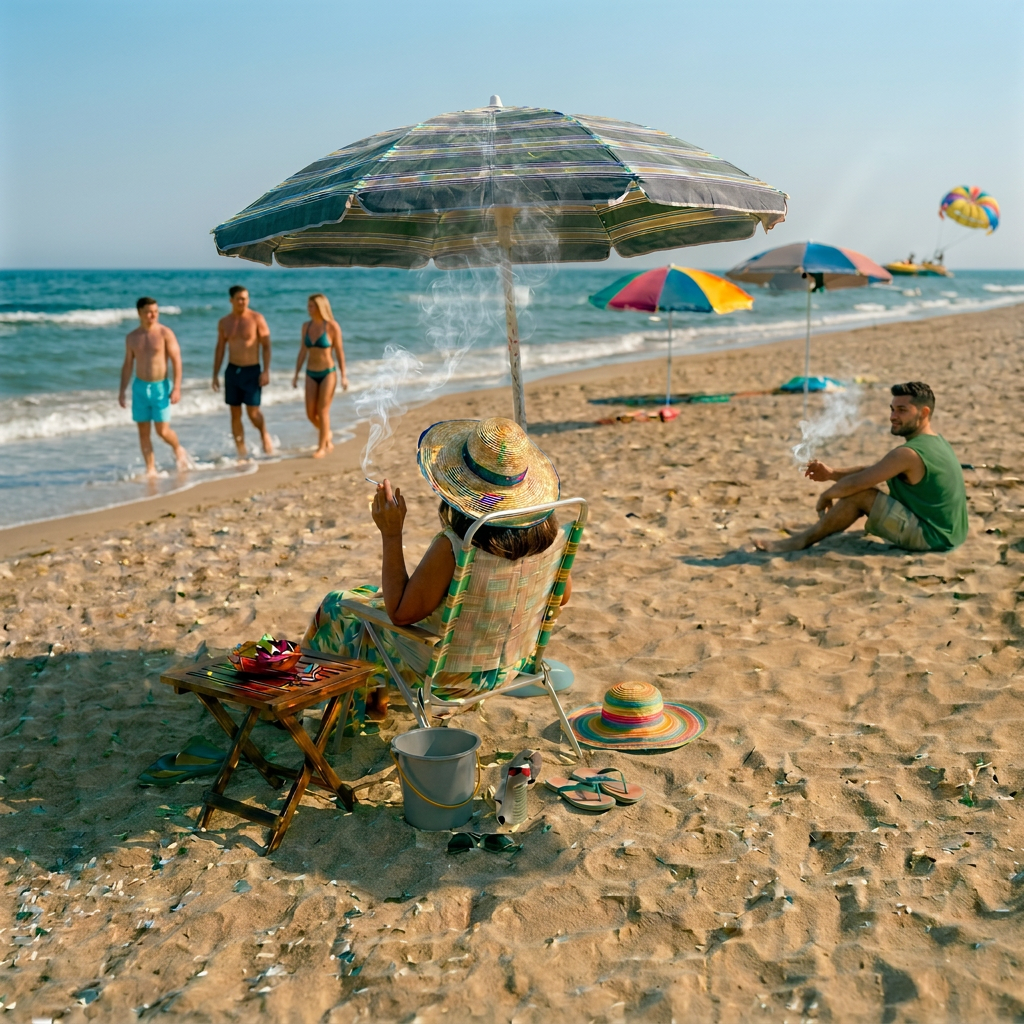
She’s sitting beneath a crooked beach umbrella, its fabric a little worse for wear. A wide-brimmed hat covers her eyes, shielding her face, and her arms are bronze from the sun and quite thin. Her skin is the texture of old leather and roadmapped with small brown birthmarks. Her flower-print dress is long, and it flutters in the breeze blowing off the sea. A half-smoked cigarette burns between two bony ring-encrusted fingers. Or is it a cigar? He isn’t sure. Or perhaps it’s something hand-rolled or maybe a joint, but there’s no distinct odor of marijuana.
Michael is sitting a short distance from her, watching the sea. Its color is the same crystal blue as the sky. It’s bright, sunny, and hot, and there is the distinct scent of sea salt and seaweed in the air. He smokes a cigarette of his own, or at least he’s holding one. He’s only taken one drag from it since lighting it. He sits on the sand, his knees drawn to his chest, and the cuffs of his linen pants begin to collect windblown sand and dried seaweed. He looks at the tiny mounds with detachment, but he’s too lazy to shake them out. He has other things on his mind.
He watches the woman again. She brings the cigarette — or cigar, or joint — to her lips and takes a long drag from it. She tilts her head back and blows a plume of smoke into the air. The sea breeze carries it off swiftly. Only then is he able to catch a glimpse of her face. She’s older. Much older than he is. She’s beautiful, with long black hair, dark eyes, and fleshy lips. Deep lines are etched around the corners of her mouth, an indication of someone who smiles a lot. She turns her head to face him. Yes, she’s a very beautiful woman, and something radiates from her, something he can’t quite explain. Her eyes study his face, noting the bits of sand now stuck to his long, unkempt beard.
‘You don’t swim, do you?’ she asks.
It takes him a moment to realize she’s addressing him. ‘Me? No, not really.’
‘You keep looking out at the sea, as if you want to enter her. It’s safe here. No sharks. Only rocks, seaweed, and sea urchins. Maybe some fish.’
She has a very pleasant voice, a Greek-accented English, spoken well enough to have spent a lot of time in America. Either that or she’s well-educated. He doesn’t answer her.
‘You are American?’
He looks at her. ‘I am.’
‘I don’t know how, but I can tell you’re Greek.’
‘Greek descent,’ she says.
‘Where in America?’
‘New York.’
“Ah, of course. I have a daughter and grandchildren in New York. They live in Long Island. You?’
‘Queens,’ he says.
‘Astoria? A lot of Greeks there.’
‘Nearby. And it’s changed. Not as many Greeks.’
‘Really,’ she says, then takes a drag from her cigarette. ‘I haven’t been there in years. My daughter and husband lived there before they moved to the suburbs.’
They both turn their attention back to the sea, each seeing something different. He watches the endless horizon, the sun glaring off the water in tiny fractals. He has no idea what she sees, but the expression on her face indicates it’s something wonderful, something private. He wishes he could see what she sees. He’s long past seeing anything that way.
He had come to the island alone, one day earlier. The ferry dropped him off at the quay in the late afternoon. He only had a small duffel bag over his shoulder and the clothes on his back. He chose this particular island because that’s where Thaïs came from. It was another chance to be closer to her, to feel her presence. No one was there to meet him. He hadn’t told anyone he was going, and he certainly didn’t tell anyone he was coming. After docking, he walked over to the pension where he had booked a room. When he arrived, it looked half-abandoned, and he worried he had come to the wrong place. It wasn’t abandoned, and his room was waiting for him. He checked in. His room had two windows and a ceiling fan that didn’t work. No air conditioning. That didn’t matter. The sea breeze blew through the windows, providing enough comfort. He had a nice view of the sea, and the sea was quiet, and the sky above it looked like an old postcard from someone’s Mediterranean travels, only not as faded and weathered. He dropped his bag on the floor and sat on the bed. The mattress was thin, and the bedsprings creaked. Not the most comfortable bed, but that didn’t matter either. What did anything matter anymore? He hadn’t brought much. A little money, a Kazantzakis paperback, his clothes, and a bottle of sleeping pills. He didn’t even bring his cellphone. He left it behind with a note. He wanted no attachments, no distractions. He wanted things old school, like they were in happier times. The island seemed perfect for the kind of silence he sought. The silence of something older.
He had been sitting on the beach since early morning. When he got there, the older woman was already there. He sat down and stared out at the sea, trying not to remember, but it was impossible not to. He had lost track of time, but judging by the angle of the sun, it was not yet noon.
‘You look like a man who once loved someone,’ the old woman says, facing him again.
He looks at her, then back at the sea. ‘You don’t know me.’
‘No, I don’t, but in a way I do. It’s something I learned to see in my old age.’
He doesn’t answer her. The corners of her lips pull into a smile, and she eyes him with empathy. It’s not quite pity. She understands. It’s written all over his face, something his bushy salt and pepper beard cannot hide. She determines it’s best to leave him alone and turns her gaze back towards the sea. He looks at her and feels ashamed of himself. He’s too embarrassed to apologize. Instead, he gets up and leaves.
. . . . . .
The next morning, he goes back to the same spot on the beach. The old woman is there again, sitting under her umbrella and smoking her cigarette, only this time she’s reading a book, something in Greek. Beside her chair is a small tray of olives, cheese, and a small knife. It looks as if she hasn’t touched it, but it’s there if she wants it. She doesn’t look at him this time. He wonders if that’s because he’s gone unnoticed or if it was an appropriate response to yesterday’s rudeness.
He looks out at the sea. It calls to him. There’s an urge to go into her. Perhaps that is one way, he tells himself. He’s not prepared for a swim; however, the sea keeps calling him. He stands up and lets his pants drop onto the sand. Then he removes his shirt, kicks off his sandals, and starts walking towards the water. Only then does the old woman look at him, somewhat amused by this hairy, overweight American walking towards the sea in his boxer shorts. He tests the water with his toes. It’s warm. He enters her, walking out just far enough to float on his back, but shallow enough so he can feel the sea bed if he stands. He floats like that for a long time, his eyes closed, the sun baking the skin of his face, shoulders, and chest. The breeze alleviates the heat somewhat. He then turns over and does a few breaststrokes before briefly dunking underwater. When he resurfaces, the salt water stings his eyes. He starts walking out of the water. The old woman had been watching him the whole time.
‘You swim,’ she says as he passes her. ‘It suits you.’
He sits down where he left his clothes. He has no towel to dry himself, so he allows the sun to do it. What was I doing when I was in the water, he muses. He grabs his shirt and removes his pack of cigarettes from the pocket. He places the cigarette between his lips and lights it. Over the flame of the match, he can see the old woman watching him. The cigarette is soothing, as is the sea breeze.
‘You were married,’ the old woman says. ‘Then you were not.’
He looks at her but doesn’t say anything.
‘Or perhaps you were married to something else,’ the old woman says.
He doesn’t respond.
‘I was married once,’ she says. ‘To an artist. A sculptor. He made things out of driftwood. He wasn’t very good, but he was a beautiful man. A very kind soul.’
He looks at her. She’s smiling. Her eyes are kind.
“What happened to him?’
She waves her hand. ‘He went to Paris to become a famous artist,’ she says. ‘He didn’t become one, and I never saw or heard from him again.’
This makes him laugh, although he isn’t sure why. He doesn’t know what to say to her, if anything.
‘You’re not here for the sun, or the scenery, or the peace and quiet,’ she says. ‘You’re here for something else, aren’t you?’
‘I’m here to rest.’
She nods, takes a drag off her cigarette, then stubs it out in the sand. She reaches for the tray of olives and cheese and holds it out to him. ‘Would you like some?’
‘No, thank you.’
She nods again, places the tray on her lap, and pops an olive into her mouth. ‘So you’re here to rest,’ she says, still chewing the olive. ‘What do you need a rest from?’
‘Why do you care?’
‘I don’t,’ she says with a hint of annoyance. ‘But I’m old, and I like to know who I’m speaking to.’
He looks away, towards the horizon. Then he laughs. ‘I’m sorry,’ he says. ‘I don’t mean to be so ornery.’
She just looks at him and pops another olive into her mouth. She puts the tray down on the sand and opens her book. She no longer pays attention to him.
. . . . . .
The room is warmer than it was the night before. Lying in bed, reading, the breeze isn’t coming through the window but blowing in a different direction. He can’t focus on the book, finding himself rereading the same paragraph, then the same sentences repeatedly. He places the book face down on the bed and reaches for a cigarette. He eyes the bottle of sleeping pills on the night table next to the bed. He lights the cigarette and walks over to the window, looks out at the sea. It’s dark, and only a sliver of moonlight makes the water visible. He knows his restlessness has nothing to do with the heat, the lack of breeze, or even his intrusive thoughts. It’s the old woman and his behavior towards her. Was this the man you married, Thaïs?
He takes one last drag from the cigarette and flicks it out the window. He eyes the bed, but he doesn’t move. Now? No, not now. There are still things to consider.
. . . . . .
The following morning, he doesn’t return to the beach. Instead, he explores the village. It’s exactly as Thaïs once described it, to such an extent that he feels he had been there before. He had only seen a few snapshots of it, those of Thaïs in her youth. It hasn’t changed much since those days, and he almost half-expects to see Thaïs moving about the crowd, her dark hair covering her face, her summer dress billowing in the breeze. What he doesn’t want, and fears, is running into one of her relatives, which is likely in a place as small as this. He wanders through the streets, narrow and ancient, past the cafés and small tavernas, the odor of grilled seafood hanging in the air by an already oppressive heat. Past the old men sitting around playing backgammon and sipping ouzo and retsina. Past the young mothers pushing their newborns around in their strollers on their morning shopping runs. Past the street vendors selling everything from cheap knock-offs to handmade artisan crafts. Past the food vendors offering souvlaki to gyros to koulouri to loukoumades. All of it makes him hungry, but it’s too early to eat. At least it is for him. Thaïs always chided him for skipping breakfast. Yes, Thaïs, I’m skipping breakfast again, he tells her silently. What does it matter now?
He would have liked to come here with Thaïs, but they never did. Not once in all those years. She traveled back and forth numerous times to visit cousins, aunts, uncles, and childhood friends. He wanted to go, but something always came up. Thaïs was a creature of her environment, and the more he strolls around the village, the more he sees her face in the women he encounters. He hears her voice whenever they speak. I feel you here. Did you return? Are you among them again?
. . . . . .
Her name is Eleni, he learns, and she has lived on the island for decades. She once lived in Athens, but she never liked urban life and preferred to live by the sea. She left Athens for the island after her husband left her for Paris, his mistress.
‘I need to live by the water,’ she says. ‘I don’t trust people who live far from the sea.’
‘Why’s that?’
‘They’re disconnected,’ she says. ‘From source.’
He has no idea what she’s talking about, but at least this time he’s allowing her the courtesy of being listened to. She speaks of many things: the moon, the sun, astrology, the sea, what it means when cats disappear for days on end, and other eccentricities which perfectly complement her quasi-bohemian appearance. She isn’t wearing her wide-brimmed hat this afternoon, allowing her midnight black hair to fall loosely around her bronze shoulders and blow freely in the sea breeze. It also allows him to take a better look at her face. He doesn’t know how old she is, but it’s apparent she’s well into her seventies. She wears little makeup, a simple dark eyeliner, a little mascara, and a light coating of lipstick. She speaks with enthusiasm about everything, which makes her eyes light up and hold your attention. Her thick Greek-accented English reminds him of his mother-in-law. Thaïs spoke with a heavy accent, too, but he no longer heard it. In a way, Eleni could be what an older version of Thaïs would have been had she never left the island. He doesn’t say anything about Thaïs to Eleni. He doesn’t say much of anything at all and allows her to do most of the talking, so much so that he senses the growing weariness of her own voice by how long the pauses become between her sentences. He knows he should say something, but he can’t find the words.
‘I’ve done enough talking,’ she says, lighting one of her slim brown cigarettes. ‘You haven’t said much of anything. At least you’re listening today.’
‘I didn’t mean to be so rude earlier.’
She smirks, then smiles. ‘I know,’ she says. ‘Whatever is troubling you radiates off you. You don’t need to be psychic to know that something is deeply troubling you.’
He doesn’t say anything. Her eyes study his face, and she takes a long drag from her cigarette. ‘Of course, I’m not pressing you,’ she says. ‘Nor judging you. Just observing you. You’ll speak when you’re ready to speak.’
‘It’s not you,’ he says.
‘I know. I’ve been around long enough to be able to read people. You live long enough, you get good at it. I know it has something to do with love. You have that expression on your face that can only come from heartbreak. Of course, I don’t know the source of it.’
He doesn’t say anything, looks away. She begins to gather her things, looks at him with both empathy and curiosity.
‘Not to be rude,’ she says, ‘but I have errands to attend to. How about if we meet again tonight? At my place.’ She points to the top of the hill behind them. ‘There’s one house up there. It’s mine. We can sit in the garden. We’ll have wine.’
. . . . . .
They drink wine at a mosaic café table under a fig tree. A table she made herself, she says. The crickets are loud, and the wine is a little dry for his taste, but it’s pleasant, and it perfectly complements the solitude of the small garden. It shows evidence of Eleni’s naturally green thumb and the dedication it took to construct it.
‘I don’t know what I’d do if I didn’t have this garden,’ she says. ‘It’s my sanctuary. My Eden.’
‘You don’t ever feel lonely?’
‘Solitude and loneliness are two very different things.’
The garden is only steps away from the entrance to the house, which by all appearances is as eccentric as its occupant. Colors, mosaics, murals, a lifetime of work went into it. She sips her wine and studies her guest with an intense curiosity. Until now, she hasn’t pressed him on anything, but it doesn’t matter. It’s nice to have company.
‘Do you believe in astrology, Michael?’
‘Not particularly.’
‘I didn’t think so.’ She lights a cigarette, sips her wine. ‘My husband didn’t either. He didn’t believe in anything. Only in himself. Sometimes I felt sorry for him because of that.’
‘How come?’
‘You have to believe in something greater than yourself,’ she says. ‘It can’t possibly be all about us. I can’t believe that.’
‘Some people do.’
‘Do you?’
‘I don’t know anymore.’
‘Heartbreak is written all over your face. Your beard does nothing to conceal it. It’s in the eyes. The eyes never lie.’
He doesn’t say anything.
‘There’s a particular melancholy about you. I don’t understand why.’
He looks at her.
‘I’m not pressing you,’ she says. ‘It’s just an observation. I noticed it the moment I first saw you on the beach.’
He looks away, listens to the crickets, and watches the flowers flutter in the evening breeze. He’s under a microscope. He doesn’t like it.
‘It’s peaceful here, don’t you think? How long are you planning to stay?’
‘I’m not sure,’ he says.
‘Until you find what you’re looking for.’
‘Who says I’m looking for anything?’
‘Your eyes.’
She sips her wine and takes another long drag from her cigarette. She sits back in her chair and looks up at the stars. He looks up, too. The sky is full of stars.
‘Do you mind that I keep asking these questions?’
‘I don’t mind.’
‘But you have no intention of answering them,’ she says. She sits up in her chair and looks at him. ‘Life is hard,’ she continues. ‘Believe me, I know. The longer you live, the more apparent that is. It’s a never-ending cycle of hope and despair, happiness and sadness, struggle and ease, laughter and tears. It’s really a matter of deciding where you place your focus.’
He looks at her and smiles.
‘I like that,’ she says. ‘You have a very nice smile under all that hair. It’s telling.’
“What does it tell?’
‘That you’re really not as dour as you like to pretend.’
‘Maybe I’m not pretending. Maybe I’m going through one of those cycles.’
‘Maybe you are,’ she says, ‘but there’s something about you. I haven’t quite figured it out. Something tells me you’re not always so glum. Something happened to you. A matter of the heart.’
He doesn’t say anything, looks down.
‘Sometimes you have to work through it, no matter how dark it gets,’ she says. ‘Yin and Yang, right? Light and shadow. We all face it. No one is immune.’
‘Some people never find their way out, no matter how hard they try.’
She looks at him, her eyes narrowing behind a tendril of smoke. ‘I knew someone once, many years ago, who used to say things like that. Sometimes it feels as if there’s no way out but one. Usually, it’s a permanent solution to a temporary problem. This person I knew was right on the edge, but they stepped back.’
‘Some people can’t step back.’
‘I know,’ she says.
He looks at her watching him, her eyes studying his face. She has very beautiful eyes. Dark and mysterious. She was right about how the eyes never lie. There’s a story in hers which she isn’t telling either.
‘Do you know why Greeks place coins on the eyes of the dead?’
‘To pay the ferryman,’ he says.
‘Ah, you know your myths. Yes, that is correct, but also, so the dead don’t open their eyes again.’
He gives her a questioning look, then says, ‘There are worse things than dying, sometimes. Sometimes waking up again is one of them.’
She sips her wine, says, ‘Yes, we do. Even when we don’t want to.’
. . . . . .
He arrives at the beach early the next morning, at sunrise. Eleni isn’t there, and all is quiet except for the waves rolling up along the shore and the occasional chirping of seagulls. He’s prepared this time, donning a pair of swimming trunks. He kicks off his sandals, takes off his shirt, and then walks into the water. The water is colder than he expected, and he slowly wades through it until it’s deep enough to dive in. He swims, or his version of it, until he’s had enough and he’s floating on his back. He feels the weight of his torso, evidence of the pounds he had packed on over the years. The sea doesn’t mind. She takes all comers. All it would take is just to go under and take a deep breath. He thinks about it but also knows he’s not going to do it. Silence. There’s something soothing about it. He drifts, allows himself to bob amongst the waves in a sort of maritime crucifixion. He thinks of Thaïs. She must have swum in these waters dozens of times over the course of her life. Is she with him now, he wonders? He floats like this for a long time, trying to blot out all thought, to think of nothing, and just go with the waves. He can only accomplish this momentarily. He’s returned now, anxious, melancholic. He opens his eyes and looks towards the shore. He had floated out a good distance. At her usual spot on the beach, Eleni has set up her chair and umbrella. He wonders why she comes out here each morning, to the same spot, and presumably, the same time. He starts swimming towards the shore.
‘Did you sleep well?’ Eleni asks as he walks towards her.
‘Not really,’ he tells her, then takes a seat on the sand beside her. ‘The water’s a little cold.’
‘It’ll warm up. I’m glad you went for a swim. It’s good for you.’
‘How come you never go in the water?’
‘I can’t swim,’ she says.
He laughs. ‘You’re kidding me.’
‘I wish I were. The most I do is wade.’
She lights one of her cigarettes and looks down at him. ‘Why not go back in? It seems to relax you.’
‘Maybe I will.’
He walks back into the water. He swims out further this time and just keeps going, far enough so that his feet no longer touch the seabed. He stops swimming and looks back towards the shore. Eleni is nothing more than a spot along the sands. He floats on his back, allowing the rising sun to warm him. He thinks of nothing, or maybe everything. He’s in a special place now. He feels Thaïs’s presence this time, and all it would take is to simply sink beneath the waves and join her. There is a moment where he’s about to do just that. Then he doesn’t. Instead, he starts swimming back towards the beach.
When he returns to the shore, he walks towards Eleni, who is sitting up in her chair with a towel on her lap. She hands him the towel, and he begins to dry himself. The towel smells of rosemary.
‘Something changed,’ she says, shielding her eyes from the glare of the sun. ‘You went very far out, didn’t you? With determination, mind you.’
He dries his hair and beard, then hands the towel back to her. ‘Maybe,’ he says.
‘You came here to die, didn’t you?’
He doesn’t answer her.
‘I was thinking about our conversation last night, and some of the things you were saying. You’re trying to make peace with it.’
He sits down beside her, looks out towards the horizon.
‘But you haven’t made peace with it,’ she continues. ‘You haven’t made peace with anything. Now you seem like someone who wants to be punished. For what, I don’t know.’
He looks at her, then down at the sand.
‘I guess you thought that’s easier than forgiving yourself.’
She lights a cigarette and hands it to him. He takes a long drag from it. It’s harsh on his throat. She touches him lightly on the shoulder. ‘Whatever you lost, you haven’t buried it deep enough. At least not yet.’
‘There wasn’t anything I could do,’ he says after a long silence, still gazing out at the sea. ‘Not a damn thing. But I tried. I really did.’
She touches his shoulder again. It’s comforting. For both of them.
‘The bottle of sleeping pills was still in her hand,’ he says. ‘There wasn’t anything I could do. It was too late.’
‘It’s not your fault,’ she says, still touching his shoulder.
‘Isn’t it?’
‘No,’ she says. ‘It isn’t.’
‘I could have done something. Anything. I tried. I really did, but…’
‘You have no control over what others do, once one’s mind is made up. She made her decision. Without you. There wasn’t anything you could have done.’
‘I don’t believe that.’
‘Therein lies your problem. You feel responsible. But you’re not responsible.’
‘You seem quite sure of yourself.’
‘Yes, I am quite sure.’
He looks up at her. She looks away, the wind blowing her hair across her face, hiding it, so she doesn’t have to do. Only then does he understand.
‘I’m sorry,’ he says. ‘I didn’t know.’
‘How could you?’
‘You were trying to tell me. Last night.’
‘That was so long ago now, I’ve nearly forgotten. I was a different woman then.’ She brushes her hair from her face and looks at him. ‘He never knew, my husband. I don’t know if he would have cared.’
‘I’m sure he would have. You did say he was a kind soul.’
‘Maybe, but I’m not sure he would have. You shouldn’t feel responsible for what happened. Her battle wasn’t with you.’
He doesn’t say anything and looks out towards the sea again. It’s tranquil, still, and it glistens in the morning sunlight.
‘She wouldn’t want that for you,’ she says. ‘In her own way, she felt she was freeing you.’
‘From what?’
‘Whatever she was fighting. She wouldn’t want you to follow her. That’s not part of the plan.’
‘It seems so absurd.’
‘It is,’ she says. ‘Very much so. But we have to find meaning in it all. That’s the best we can hope for, I guess.’
‘Did you?’
‘I’m here talking to you, aren’t I?’
. . . . . .
He spends the next two days alone. He avoids going to his usual spot on the beach in favor of another, a little further away. For two days, he sits on the edge of a bluff staring out over the sea. It is here that he can speak to Thaïs and hopes she will listen. For two days, he speaks to her, carrying the empty bottle of sleeping pills that he had taken from her hand. It’s on the second day that he senses her, that she is indeed listening to him. He doesn’t actually hear her voice, but he can feel her, in the breeze, in the waves of the sea, in the scrub and stones beneath him, in the grains of sand and dirt that find their way into his shins where he had rolled up the legs of his pants, in the salt in his hair and beard. Yes, she’s with him again, and she’s speaking to him, though he isn’t quite sure how. Listen to her. A peculiar calm comes over him. Yes, now he understands. Without knowing why, he stands up and looks at the empty pill bottle in his hand. He reads the prescription label, reads her name. A little laugh escapes his lips. They spelled her name wrong. He tosses the bottle into the sea. He watches it float away and keeps watching it until he can no longer see it.
. . . . . .
At mid-afternoon, the next day, he waits by the dock for the ferry to the mainland. It’s a hot, breezy day. He purposely avoided Eleni. He’s not sure why. With some time to kill, he sits on a bench and lights a cigarette. Only a few people are waiting for the ferry. He looks out over the water towards the direction the ferry will arrive. There’s no sign of it.
‘You are leaving,’ comes a voice.
He looks up to see Eleni standing before him, her hair blowing in the breeze from under her wide-brimmed hat, a pair of sunglasses hiding her eyes. The sunglasses make her look younger. The bangles on her wrists keep sliding up her arm as she pulls the strands of hair away from her face. A small canvas tote bag hangs over her forearm.
‘Yes,’ he tells her. ‘It’s time.’
She nods, then says, ‘Good. You should. There’s nothing for you here.’
He doesn’t say anything, looks at her.
‘You won’t go back the same,’ she says. She lights one of her thin brown cigarettes and looks out over the water. ‘You didn’t say goodbye.’
‘Nothing personal.’
‘I understand.’
She sits beside him, rests her arm over the back of the bench, behind his shoulders.
‘To be honest,’ he says, ‘I’m not sure if I want to go back.’
‘That’s how I know you’re ready to.’
They both say nothing and watch the sea. The breeze carries the scent of her perfume.
‘You’ll forget this place,’ she says. ‘Eventually.’
‘No, I don’t think so. I needed to come here. For a different reason than I initially thought.’
‘No, you won’t,’ she says. ‘You may try, but you won’t.’
He looks at her. ‘Thank you.’
She smiles and touches his shoulder. Then she kisses his cheek.
‘I probably won’t see you again,’ she says.
‘You never know. I may come back. Someday.’
‘No, you won’t be back. You have no reason to.’ She takes a drag from her cigarette and looks out at the sea again. In the distance, the ferry makes itself visible. ‘I’m glad we met, though.’
‘Yes, me too.’ He looks at her. ‘I mean that. I think she wanted us to.’
‘Perhaps,’ Eleni says. She reaches into her tote bag and removes a small bronze coin. She studies it a moment, then hands it to him. ‘I’ve been wanting to give this to you for the past couple of days, but I didn’t see you.’
He takes the coin from her. It’s Roman. He gives her a questioning look.
‘I have many of them,’ she says. ‘It’s not valuable. I think it once belonged to my husband. He liked to collect them. I’m not even sure where he got it. I want you to have it. It’s for the ferryman.’ She smiles and kisses his cheek.
He thanks her and drops the coin into his shirt pocket.
‘I figured it’s something you’ll remember me for.’
‘I’ll never forget you.’
‘That’s nice to know.’ She looks out towards the ferry as it approaches the dock. ‘I won’t forget you, either.’
She stands up and places her tote bag over her shoulder. They just look at one another, saying nothing. Then, without another word, Eleni walks away. He watches her, her long dark hair blowing in the breeze, until he no longer sees her.
The ferry sounds its horn and begins preparing to dock. He gathers his belongings and waits in line behind the others. He takes one last look over the island. Yes, he’s ready now, though he has no idea what’s to come. He touches his breast pocket, feels the coin behind the fabric. It’s been a long time since he felt anything other than pain.
New York City
August 2025
Connect with Julian Gallo on Facebook
Julian Gallo is the author of ‘Existential Labyrinths’, ‘Last Tondero in Paris’, ‘The Penguin and The Bird’, and other novels. His short fiction has appeared in The Sultan’s Seal (Cairo), Exit Strata, Budget Press Review, Indie Ink, Short Fiction UK, P.S. I Love You, The Dope Fiend Daily, The Rye Whiskey Review, Latinoture, Angles, Verdad, Modern Literature (India), Mediterranean Poetry (St. Pierre and Miquelon), Borderless Journal (Singapore), Woven Tales, Wilderness House, Egophobia (Romania), Plato’s Caves, Avalon Literary Review, VIA: Voices in Italian Americana, The Argyle, Doublespeak Magazine (India), Bardics Anonymous, Tones of Citrus, The Cry Lounge (Germany), Deal Jam, 22/28, Active Muse (India), Zero Readers, Hominum Journal, Write Now Lit (Nigeria), MiniMAG, Paradox Magazine, Penman Review, Lowestoft Chronicles, Marrow Magazine, Lanae Literature and Review, Helix Literary Magazine, Flora Fauna (Upcoming), and Pattern Recognition (Upcoming).

Please don’t forget
to support the writer!
Tell us your thoughts
Share this page
Visit Julian
Choose Your Next Read
Page 1
From The Lit eZine Desk
Page 2
POETRY
Love as a Carnival of Masks
Page 3
POETRY
Sometimes We Draw
Page 4
POETRY
Do You Still Call Here Home?
Page 5
POETRY
Alone With Herself
Page 6
POETRY
New Slavery
Page 7
POETRY
Father and Sons
Page 8
POETRY
Bad Actors
Page 9
POETRY
When Soldiers Come
Page 10
POETRY
Trace Evidence
Page 11
POETRY
Grizzly Man
Page 12
POETRY
Application
Page 13
POETRY
Pride Without the Fall
Page 14
POETRY
Residue
Page 15
POETRY
When did they become them?
Page 16
FICTION
The Voyage of the Silver Tide
Page 17
FICTION
For The Children Who Lost
Page 18
FICTION
The Dinner Party
Page 19
FICTION
Winston~ The Quest of Questions
Page 20
FICTION
Ataraxia
Page 21
PICTURE PROMPT
The Song of the Birds
Page 22
Meet The Team
Page 23
Coming up Next in December 2026
 Manic Sylph Writes... Poetry & Thoughts by Mona Soorma