
SHORT STORY
VOYAGE OF THE SILVER TIDE
by Z I Mahmud
I
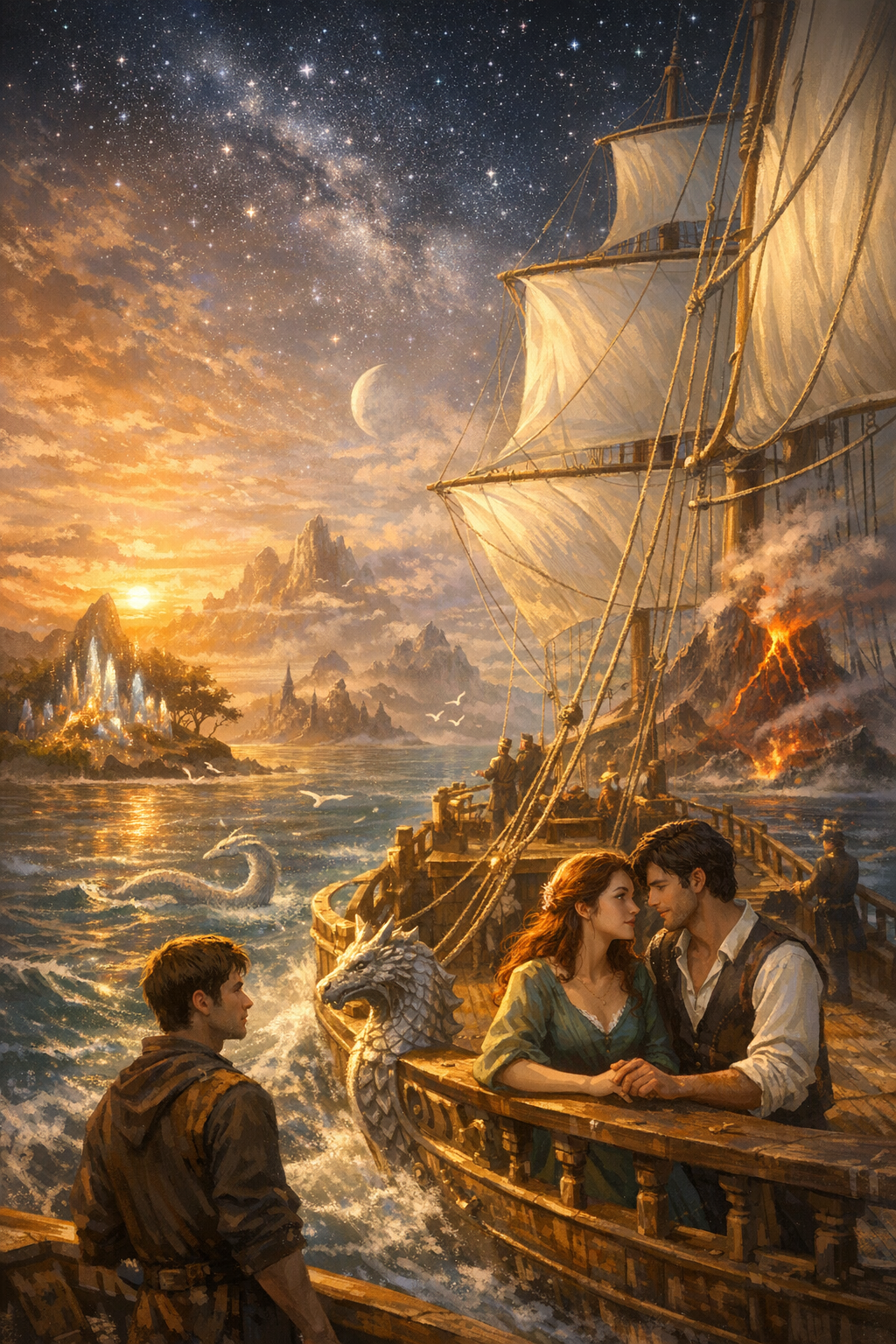
The sea whispered secrets through the salt-slicked air, and Elara felt them in her chest, where longing sat like a small, persistent bird. The tide curled around the pier like a hand reaching for her, urging her towards the ship moored in quiet twilight—the Silver Tide. Its sails gleamed like pale moonlight caught in water; its wood breathed as if alive.
Her brother, Marek, stood behind her, hands stuffed in pockets, eyes distant. The air between them was heavy with words unspoken: the argument over their father’s absence, the quiet judgment of choices left unmade. The storm of the past year had carved canyons between them, and now, like the ocean itself, they were drawn into each other’s orbit with a force they could neither name nor resist.
“Are you sure this is wise?” Marek asked, his voice brittle as old glass.
Elara’s fingers brushed the railing, tracing the grain of the ship’s timber. “The tide doesn’t ask for permission,” she said. “It just comes.”
And then they stepped aboard. The ship rocked gently, a lullaby for souls adrift, and the crew—strangers in robes that shimmered like dawn mist—greeted them with eyes that knew too much. Among them was a man named Caelum, whose smile was a map of storms and sunrises, whose presence hummed with something dangerous and tender. Elara felt her pulse twist when their eyes met.
The voyage began with a hush, the kind that stretches a heart taut. Night fell like velvet curtains, and stars became the only witnesses to their conversations—fragments of confessions, glances that lingered too long, hands brushing in corridors lined with lantern light. Marek stayed close to Elara, yet he drifted toward the stern when Caelum entered the hold, as if some invisible compass drew his attention away from her, toward a tension he could not name.
They sailed past the first island at dawn, where trees bore fruits of liquid crystal. Eating them was a memory of sunlight and loss, sweet and sharp at once. Elara’s hand grazed Caelum’s as they both reached for the same branch; sparks leapt across that briefest touch, a reminder that courage could arrive in the simplest of gestures. Marek watched, silent, the jealousy in him tempered by the memory of laughter shared on safer shores.
The next isle was shrouded in mist. Legends whispered that those who lingered too long saw their fears in flesh and bone: regrets walking like shadows, missed opportunities wearing familiar faces. Marek stepped first, hesitant, then firm; Elara followed, her heart tight with anticipation. Caelum stayed behind, waiting, a sentinel of the unknown.
There, Elara confronted her mother’s absence, the echo of her father’s harshness. Shapes emerged from the fog: a child left behind, a promise broken, a love unspoken. The air shimmered with magic; the shadows spoke in tongues only the heart could interpret. “I was afraid,” Elara whispered to the faceless echoes, the words dissolving in mist. “I am still afraid.”
And then she felt Caelum’s hand on hers. Warm, steady, insistently real. “You are braver than you know,” he murmured. And it was true—bravery not of swords or storms, but of acknowledgment, of stepping into vulnerability while the tide waited to sweep them all away.
Marek’s voice cracked through the fog. “I… I don’t know how to forgive myself,” he said. And suddenly, the mist parted for him too, revealing not monsters but mirrors: his own reflection in fractured fragments, each waiting for reconciliation. Elara pressed her palm to his shoulder, a tether across years of silence.
At night, the Silver Tide became a vessel of confession. Lanterns swung with the rhythm of waves; the stars overhead danced in constellations unknown to cartographers. Elara found herself beside Caelum, listening to stories of distant seas where islands held storms in cages and dragons slept in coral caves. Romance unfolded quietly, in shared glances, in the tender shaping of silence.
The third island was of fire and stone, a crucible. The crew warned that no heart could pass untouched. Lava rivers glowed like molten gold; jagged cliffs hummed with the pulse of the earth. Here, Marek confronted his bitterness, throwing stones into the molten tide until the act burned the anger from his veins. Elara’s courage was tested, too—not in the heat of the volcano, but in her confrontation with desire, with the pull towards Caelum that was a storm in itself.
There was laughter as they navigated the smoke-filled valleys, whispers of love mixed with the scent of ash. Elara realized that romance was not the softening of danger, but the acceptance of it, the willingness to let one’s heart sail into the unknown alongside another. Marek, seeing this, understood the delicate tension of attachment and release; the family drama softened not by forgetting but by witnessing, by acknowledging the threads that bound them.
By the time the Silver Tide departed, leaving the fire-island smoke curling like memories behind them, the bond between the siblings had shifted. They were no longer tethered by resentment, but by shared endurance. And the romance—careful, fragile, luminous—continued to grow, each touch a promise, each glance a map through the uncharted waters of longing.
The next isle was said to contain the “Sea of Lost Dreams,” a stretch of water where reflections of the past appeared as living phantoms. Sailors whispered that only those who embraced truth could pass. Marek and Elara stood at the bow, the wind carrying whispers of old arguments, laughter, abandoned hopes. Caelum’s hand brushed against Elara’s again, the warmth a steady anchor against the spectral chill.
Elara spoke into the wind, words half-poetry, half-prayer: “We cannot change the past, but we can steer through it. We can make our hearts vessels, not prisons.” Marek’s shoulders straightened. “And together,” he added, “we navigate.”
The ship glided into the mist, the sea reflecting every flicker of light and shadow. Islands appeared like islands of thought, each a meditation on courage, love, and family. Elara understood, finally, that the journey itself was the story—the romantic tension, the familial reckoning, the magical encounters—they were all currents within the same ocean.
At night, under the canvas of stars, Caelum traced constellations in the sky, murmuring their myths as if reading Elara’s pulse. Marek sat nearby, silent but attentive, feeling the old wounds loosen, the family ties rethreading with every wave’s sigh. Love, he realized, existed in layers: romantic, familial, self-forged. Each was a lantern in the darkness.
By the end of that night, the Silver Tide seemed less a vessel and more a living map of hearts. Islands, storms, and phantoms were guides, not obstacles. Romance had begun in subtle glances and gentle touches; family drama had surfaced in confessions and reconciliations; the magic of the sea carried them both outward and inward.
The horizon promised more islands, more trials, more revelations. And somewhere beyond the dawn, Elara, Marek, and Caelum knew that the true voyage was not to a distant land, but through the layers of heart and memory—each wave a stanza, each storm a line of poetry, each moment a chance to forgive, to love, to endure.
II
The dawn broke like a whispered promise. The Silver Tide glided over a sea that shimmered with silvered light, as if the ocean itself had learned to dream. Elara stood at the prow, feeling the swell beneath her feet, feeling the pulse of the water echoing in her bones. Caelum approached, quiet, his presence an unspoken answer to the storm of her thoughts. She felt the brush of his fingers, a tether, a song unsung, a truth admitted without a word.
“Do you think we’ll ever reach it?” she asked, her voice small, fragile as spun glass.
“Reach what?” he murmured, voice low enough for the sea to claim it as its own.
“Home,” she said, and the word trembled. It was not just the place of walls and roofs; it was the place of hearts that could forgive, hearts that could understand, hearts that could love without fear.
Caelum’s gaze softened. “Perhaps we are reaching it now,” he said, “not in sight, but in motion. The voyage shapes the home as much as any harbor.”
Marek emerged from the cabin, worn but steady. He watched them with an expression that was difficult to read: relief? longing? envy? All mingled in the folds of his face. He offered no words, only a nod toward the horizon, an acknowledgment of the journey yet to come.
The next island rose out of the mist like a secret. It was known among sailors as the Isle of Mirrors, a place where one’s reflection walked beside them, sometimes mocking, sometimes guiding, always revealing. Elara stepped onto the sand, the surface rippling beneath her bare feet, reflecting not just her form but her fears, her desires, her unspoken regrets. Marek followed, reluctant, but the moment his shadow touched the mirror-sand, he shuddered with recognition: the past had not been erased; it had been waiting, patient, demanding reconciliation.
“Do we face them?” Elara whispered, and her own mirrored self seemed to nod.
They walked. Reflections mimicked every step, exaggerating tremors, highlighting smiles that were too quick, laughter that was too forced. Marek confronted the shadow of their father first—stern, silent, disappointed. He reached toward it, hand trembling, and the shadow receded, folding into the sand like smoke. Forgiveness, he realized, was not about excusing but acknowledging, and the act of reaching was itself a reconciliation.
Elara faced her own reflection last, and in the mirrored eyes, she saw the desire that had been building quietly between herself and Caelum. She turned, and he was there, hand outstretched, steady, warm. She took it, and in that touch was both a confession and a vow: love could exist even in the uncertain, even in the storm-tossed hearts of the sea.
Night fell, and the stars shimmered like scattered diamonds across the canvas of the sky. The ship became a cradle, rocking them with gentle insistence. Elara and Caelum shared their first real conversation, unhurried, layered with the intimacy of knowing one another without pretense. They spoke of fears, of stolen dreams, of the longing that had followed them across every tide. Romance was no longer a whisper—it had taken form, delicate, luminous, like the silvered waves beneath them.
Marek lingered nearby, silent sentinel, carrying his own revelations. He had discovered, among the mirrors, that love was not the enemy of loyalty; that familial bonds could bend without breaking; that the sea of regrets was navigable if one dared to steer.
The following island was quieter, smaller, a jewel of emerald and gold. It was called the Isle of Lamenting Birds. Songbirds, white as clouds, perched on every branch, singing tunes that were fragments of memory, pieces of stories left untold. Marek listened first, tears in his eyes, hearing the echoes of laughter with their mother, the warmth of a father’s praise that had been withheld. Each note struck a chord of reconciliation, each melody a stitch mending frayed threads of family.
Elara wandered into the grove, where a solitary bird hovered, its feathers glinting with something impossible. She reached out, and the bird landed on her shoulder, cooing softly. It was a messenger, she realized, a symbol that love—romantic, familial, self-forged —was intertwined. Caelum joined her, their hands brushing, the warmth of fingers an affirmation. “Every song has a listener,” he murmured. “And every heart has a melody waiting to be heard.”
The climax of their journey loomed in the form of the Isle of Storms, a jagged land where thunder rumbled in perpetual twilight, and the sea around it boiled with restless energy. Legends said that no heart could pass untested, that love, loyalty, and courage would be measured against the raw pulse of nature itself.
The ship anchored, swaying with the angry rhythm of the waves. Elara, Marek, and Caelum disembarked, their steps cautious but resolute. Lightning split the sky, illuminating cliffs that seemed carved from obsidian, and the wind whispered secrets of fear and hope. Here, romance faced its trial: the pull between desire and self-preservation, the courage to claim love in the face of danger. Elara clutched Caelum’s hand, feeling the tremor of both hearts, the acknowledgment that passion was both a risk and a refuge.
Marek faced his own tempest, not of the elements but of memory. Shadows of old resentment, of guilt, of unspoken blame, rose like specters among the jagged rocks. Yet with each step, he whispered apologies to ghosts that had lingered too long. Forgiveness was not an event, he realized, but a motion—a tide that ebbs and flows, washing clean yet leaving traces of lessons learned.
The storm did not break them; it forged them. Elara’s confession of love, Caelum’s steady acceptance, Marek’s reconciliation with the past—they were all flares of light piercing the gray, illuminating the truth that had guided the voyage all along: hearts, like oceans, hold storms and calm in equal measure, and the courage to navigate them is what defines the journey.
At last, they returned to the ship. The Silver Tide seemed lighter, almost buoyant, as if it had absorbed the transformations of its crew. Stars reflected in the glassy surface of the sea, constellations dancing as if applauding the voyage. Elara leaned on the railing, Caelum at her side, and Marek nearby, each of them marked, softened, and strengthened.
In the gentle hush before dawn, Elara spoke: “We have crossed seas of fear, islands of memory, storms of heart. And yet… we are not lost.”
Caelum’s hand found hers again, warmth radiating, steady as the pulse of the sea. “Lost is a place, not a state,” he said softly. “And love is the compass that carries us forward.”
Marek nodded, the last weight of resentment lifting. “We’ve navigated more than waters,” he said. “We’ve navigated ourselves, together.”
The final island lay ahead, shrouded in mist, unnamed but familiar. It was the place where the voyage itself became a metaphor, where the boundaries between magic and memory, romance and family, myth and reality blurred. Here, the sea whispered not of challenges, but of home—not a single shore, but the constellation of hearts bound by courage, vulnerability, and love.
The siblings and the man they had come to trust gazed toward the horizon, where the first light of morning touched the waves. The wind carried a melody of all they had experienced: laughter, sorrow, longing, and the quiet affirmation that journeys end not with destinations, but with transformations.
Elara pressed her forehead to Caelum’s shoulder, feeling the steady rhythm of his heartbeat, a counterpoint to the rolling tide. Marek stood beside them, shoulders squared, a silent guardian of reconciled love. The sea, infinite and alive, held no secrets they could not face, no fear they could not meet, no longing they could not honor.
The Silver Tide began its return, cutting through silver waters as if carving a path through the poem of their lives. Islands receded, shadows fell into memory, and the horizon opened endlessly before them. Romance had bloomed, tender and courageous. Family bonds had mended, woven through confrontation, acknowledgment, and forgiveness. And the voyage—rich with allegory, adventure, and enchantment—left them changed, luminous, capable of love without fear, of embracing the currents of life with hearts as vessels, not prisons.
Elara whispered into the wind, words carried across the sea: “We are home, not because we arrived, but because we have journeyed together.”
Caelum kissed her hand. Marek smiled, quietly, a gesture of peace that spoke louder than words. And the sea—ever restless, ever tender, ever infinite—bore witness to their passage, the poetry of hearts sailing into dawn, unbroken, luminous, and whole.
The voyage would be remembered not for storms, not for islands, not for battles fought, but for the quiet truths discovered: love, in all its forms, is the true tide that shapes destinies. And in that realization, the Silver Tide sailed onward, carrying hearts, stories, and dreams across waters where magic and memory mingled, leaving only the wake of transformation shimmering in the morning light.
Connect with Z I Mahmud on his website
Connect with Z I Mahmud on Facebook
Aspiring to achieve great expectations in transnational scholarship, he seeks to acquire another Fulbright to pursue a postgraduate master’s research fellowship residency in the Western world, forthcoming creative-critical work in progress in Sage-ing The Journal of Creative Aging, Sliding Magazine and The North Meridian Press.His book chapter, Ecocosmic and Cybernetic Femininities: Posthuman Metamorphosis in Wuthering Heights and Great Expectations, appears in Emerging Trends and Future Directions in Comparative Literature (Bombay, India). Entitled with Remembering Otherwise: Childhood, Moral Awakening, and the Unfinished Self from Dickens to Twain at the Sixth Annual LITCO Symposium (Purdue University), The Poetics of Frozen Glossolalia: Mystical Grammar from Hermione’s Living Marble Statue to Havisham’s Cobweb-Laced Bridal Spectre at the 8th Annual Comparative Literature Conference, organized by the Comparative Literature Graduate Association, Louisiana State University.

Please don’t forget
to support the writer!
Tell us your thoughts
Share this page
Visit Z I Mahmud
Choose Your Next Read
Page 1
From The Lit eZine Desk
Page 2
POETRY
Love as a Carnival of Masks
Page 3
POETRY
Sometimes We Draw
Page 4
POETRY
Do You Still Call Here Home?
Page 5
POETRY
Alone With Herself
Page 6
POETRY
New Slavery
Page 7
POETRY
Father and Sons
Page 8
POETRY
Bad Actors
Page 9
POETRY
When Soldiers Come
Page 10
POETRY
Trace Evidence
Page 11
POETRY
Grizzly Man
Page 12
POETRY
Application
Page 13
POETRY
Pride Without the Fall
Page 14
POETRY
Residue
Page 15
POETRY
When did they become them?
Page 16
FICTION
The Voyage of the Silver Tide
Page 17
FICTION
For The Children Who Lost
Page 18
FICTION
The Dinner Party
Page 19
FICTION
Winston~ The Quest of Questions
Page 20
FICTION
Ataraxia
Page 21
PICTURE PROMPT
The Song of the Birds
Page 22
Meet The Team
Page 23
Coming up Next in December 2026
 Manic Sylph Writes... Poetry & Thoughts by Mona Soorma