
BOOK REVIEW
IN SEARCH OF A SALVE: Memoir of a Sex Addict
A Review by Khaya Ronkainen
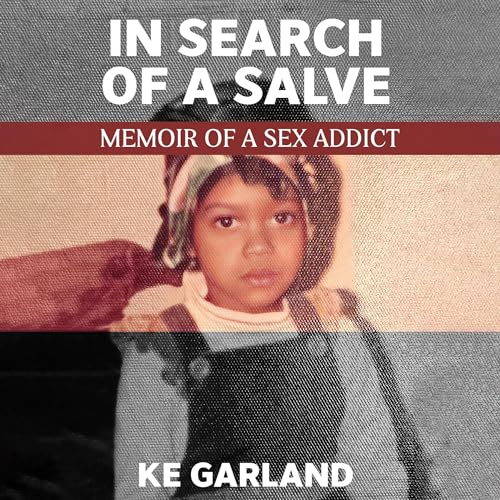
Book Review
‘‘A heartbreaking, heroic and enlightening story”— Khaya Ronkainen reviews KE Garland’s debut memoir
In Search of a Salve: Memoir of a Sex Addict
“Our mothers are our first homes, and that’s why we’re always trying to return to them.” Michele Filgate’s observation is fitting for this memoir’s overall view.
KE Garlands’ book In Search of a Salve: Memoir of a Sex Addict is a deeply personal and emotional journey about the secretive yet reckless world of a sex addict. It confronts the reader with the ugly truth of living a double life as the author weaves a story that is both raw and tender. In examining the protagonist’s life, topics such as abandonment, trauma, grief, anxiety, and all things that lead to her sex-addiction as a maladaptive coping mechanism are explored.
At the beginning of the book, the reader is presented with a nine-year-old girl who discovers a pleasurable sensation from squeezing her legs together; a discovery that didn’t happen by chance. But this is not where the entire story begins, rather with the protagonist as a five-month-old baby left alone in an apartment by her birth mother. A consequence that saw the baby placed in a foster care facility and later adopted by well-meaning parents. Throughout the book, the author tries to return to the source, her biological mother, even though it’s not the safest place.
“When the janitor found me at five months, I was only seven pounds. My mother had no other recourse but to leave me in an apartment building. I waited for her to feed and care for me. She didn’t. She couldn’t. She didn’t have the capacity. However, I was severely malnourished not only in my body but also in my mind and spirit. I began life, like most babies, listening for the sound of my mother’s voice and never found it, and I’d never stopped longing for her.”
This is not forgetting the crucial role fathers play in their daughter’s lives. Essentially, it’s the first relationship a girl child has with a man. It’s a relationship filled with love and trust as well as one that provides safety. However, this proves not to be the case for the protagonist because during her teen years, her adoptive mother dies and the adoptive father gives up his parental rights. How to proceed in this case? As the author puts it:
“What do you do when your mother suddenly dies, and your father abandons you? … I internalized rejection and became clingy and codependent, looking for proof that I mattered in the crevices of dark Chicago streets or within the tautness of my relationship.”
The book unfolds over four parts. “Rooted” (Part I) explores how the main character’s childhood shaped her understanding of sex and sexuality. This section is disturbing because the protagonist’s father and a girl from a questionable background take over sex education instead of the mother. Later on, trust is broken between daughter and father as boundaries are crossed, causing a rift between them. The mother fails to speak up and once again confirms adults cannot be trusted.
In “Addicted” (Part II), the protagonist goes through more major traumatic events in her young life. With her unaddressed trauma, unspoken grief and unregulated emotions, she finds solace in alcohol and in any man who gives her attention. It’s the numbing that provides instant relief but also a vicious cycle with severe consequences. Unplanned parenthood and pregnancies lead to abortions; the shame-inducing incidences that add to the trauma.
“Trapped” (Part III), in this section, the author painstakingly pieces together events to show how exhibitionism plays out. By now, the protagonist’s exhibitionism disorder has spiralled out of control. There’s nothing sexy or amusing about wanting to show private parts of your body to strangers. It’s downright dangerous. Not only are the events vivid, but painful because the protagonist is excelling and progressing in every sphere of her life. She’s highly educated, has a suitable career, is married to a sensible man and has children she adores. She is success! That’s why people in her life do not see her peculiar behaviour as an addiction. In fact, the protagonist, herself, is not aware she has a problem. And the author later reflects on this lack of awareness.
“Had I realized I had a problem, instead of a personality flaw, I wouldn’t have dated Brent, much less married him. I would have asked Grandma Hunny to fund therapy sessions instead of reception dinners.”
It’s also no coincidence that the protagonist pursues an affair with a male colleague. She can’t help herself, even though the risk is huge. If the word came out, it would be a scandal that would tarnish their reputations. Because not only are the characters both married, they are also teachers at the same school. But this affair didn’t happen without the protagonist trying to seek help, advice and discussion about. Out of the few close people she reaches out to, it’s only her father who outright cautions against it. Regardless, the protagonist falls right into the colleague’s arms. Not even this affair satiates her sexual cravings, prompting her to seek encounters with various men. This signifies that this is not about willpower or morals but about an untreated disorder.
In “Self-Regulation” (Part IV), the author adopts a comprehensive and pragmatic approach to tackle her addiction. The path to healing necessitates her returning to the start and meticulously assembling the fragments of her birth story. This uncovers the woeful realities that confronted her young mother. Among them were an unstable home, a system that failed to offer decision support and mental illness that led to the heartbreaking choice she had to make.
The author is generous as she embarks on her healing journey. Because she shares the backstories of significant characters in her life, and this helps to understand each character’s motives. But she also scrutinises characters for their flaws, such as lack of empathy, evading crucial discussions, lacking support, abandoning her, or dying and leaving her to deal with the aftermath alone.
“I’d healed from three mother wounds: my biological and adoptive mothers and grandmother. Each woman physically or emotionally abandoned me in some way.”
Healing is not a straight line. While the author is making peace with her birth mother and adoptive parents now gone, there is still one piece of the puzzle missing: her biological father. After deciding to settle the matter once and for all, she conducts DNA testing and eventually locates her biological father. The mix of unique emotions that surface with finding her father threatens to reverse all the healing work she has done. To exacerbate matters, not everyone is pleased with this recent discovery. Despite the promising start, the reunion ends in a let-down, leaving the all-too-familiar sting of rejection.
“It was clear that, like my adoptive father, Mr Philip [the biological father] and I wouldn’t have a relationship, either. Neither would my younger sister, older brother and I.”
However, there’s always a silver lining, no matter how dark the clouds are. As the book nears the end, and the author continues on her healing journey, she begins to see the many blessings in her life. For instance, her birth mother’s choice of not opting for an abortion and her miraculous adoption.
The once little girl is now a mature woman who healed the mother wound. She has developed her self-identity and self-worth and is no longer afraid of the unknown. That’s why she finally comes clean to her husband and leaves no stone unturned.
“When you say affairs with an ‘s’ what do you mean? I answered, until there were no more questions, until we both stood in the silence of the truth.”
In Search of a Salve though heartbreaking is an enlightening read that encompasses various aspects. Included is the author’s personal struggle with the disease, as well as the inadequately explored scientific categorisation of the addiction or compulsions linked to exhibitionism as a mental illness. There’s also a lot to be said about deep-rooted traumas, and how if left unaddressed can cause an individual to internalise blame and avoid seeking help or early intervention. Dr. Garland is in her element as an educator and offers a highly researched account and root cause(s) of her addiction. That said, the book doesn’t read like an academic article written for a medical journal, but a moving story about our shared humanity.
While this book is not an autobiography but a memoir, it loosely borrows the procession with the story that spans from childhood and follows the protagonist throughout her life’s stages. However, this procession is cleverly done. Because the focus is on characters and the roles they play, not on the chronological dates, thus producing a character-driven story. Also, the reader is presented with a much bigger slice of life, because the protagonist has had more than one monumental event in her young life to contend with. Yet the author strings together these events and their impacts to produce a page-turning memoir.
However, a word of caution: while the book is engaging, it’s also intense and evokes all sorts of emotions. The author’s fluid writing style won’t shield you from the uncomfortable truths. If you are someone who feels deeply, pace yourself. As a reader, you can find yourself incensed by the actions or inactions of the adults in the protagonist’s life. Or vexed by the protagonist’s prevailing and seemingly negligent acts and utter disregard for the consequences.
You also might find yourself inconsolable not only for the helpless three-month-old baby abandoned in a flat for days before she is found but for her biological mother who did the best she could under the circumstances. Other times it’s a deep sense of sadness because you’re suddenly confronted by your own deep-seated traumas or ways you have failed people in your life.
Regarding characterisation, writing about real people, whether living or deceased, is a tricky business. Garland has done an admirable job of telling her story, her truth with boldness, but without hurting her loved ones. She writes the personal until it is universal. Moreover, she takes care of the reader. That is, she does not leave you raw and bleeding, but with an important lesson to learn or a shift in perspective.
When considering Garland’s body of work, which includes books such as Daddy, Unhappy Wife, among others, In Search of a Salve is a culmination of years of practice and hard work. It’s her best work yet. It also aligns with the author’s mission of speaking up on women’s health issues and affirming their experiences. To conclude, and as many have said it before, a memoirist’s job is to break silence. Garland broke hers for us to learn from her experiences. Now, the question that remains is whether you will observe from afar and point fingers or engage in the healing of your loved ones?

Editorial team member Khaya Ronkainen is a writer, poet and creative professional. Her most recent poetry collection is The Sheltering.
Find her on Instagram @khaya.ronkainen.

Please don’t forget
to support the writer!
Tell us your thoughts
Share this page
Visit Khaya
Choose Your Next Read
Author Spotlight:
Creative Non-Fiction by Evan Griffith
Author Spotlight:
Rant of Appreciation by Evan Griffith
Author Spotlight
Interview: Evan Griffith
Poetry:
My Poetic Soul
Poetry:
In the Thick of Life
Poetry:
Seasons of Gratitude and Hope
Poetry:
From the Depths of My Thoughts
Poetry:
The Rejected Soul
Poetry:
Dark Hours
Poetry:
The Nameless, Placeless
Poetry:
When the Rain Comes
Poetry:
In My Life
Poetry:
Winter is a Careful Nurse
Fiction:
It Rained That Night
Fiction:
Where Equality Reigned Supreme
Fiction:
Hazlitt and the Mobility Scooter
Fiction:
Slow Drip of Water
Fiction:
Gryphon Bay
Insights:
Almost Lost Forever: A True Story of Love and Survival
Insights:
Gratitude: A Work In Progress
Book Review:
In Search of a Salve: Memoir of a Sex Addict
Book Excerpt:
The Quantum Entanglement Party
A Writer’s Life:
John Steinbeck
Picture Prompt:
A Spectral Harmony
 Manic Sylph Writes... Poetry & Thoughts by Mona Soorma
Thank you for your thoughtful and detailed review of Kathy’s book. Her work sounds phenomenal.
LikeLiked by 2 people
Thanks very much for your appreciation! I hope you will enjoy the book as well.
LikeLike
Such a comprehensive and remarkable review! I thoroughly was mesmerized by this book. The raw honesty shone through and I highly recommend it. It gave me a lot of insight related to coping with abandonment.
LikeLiked by 2 people
Thank you very much for your appreciation and for sharing your thoughts. So glad you enjoyed reading this!
LikeLiked by 1 person
Thank you.
LikeLiked by 1 person