
Welcome to Vocabulary Wednesday
~Words To Help You Write Better
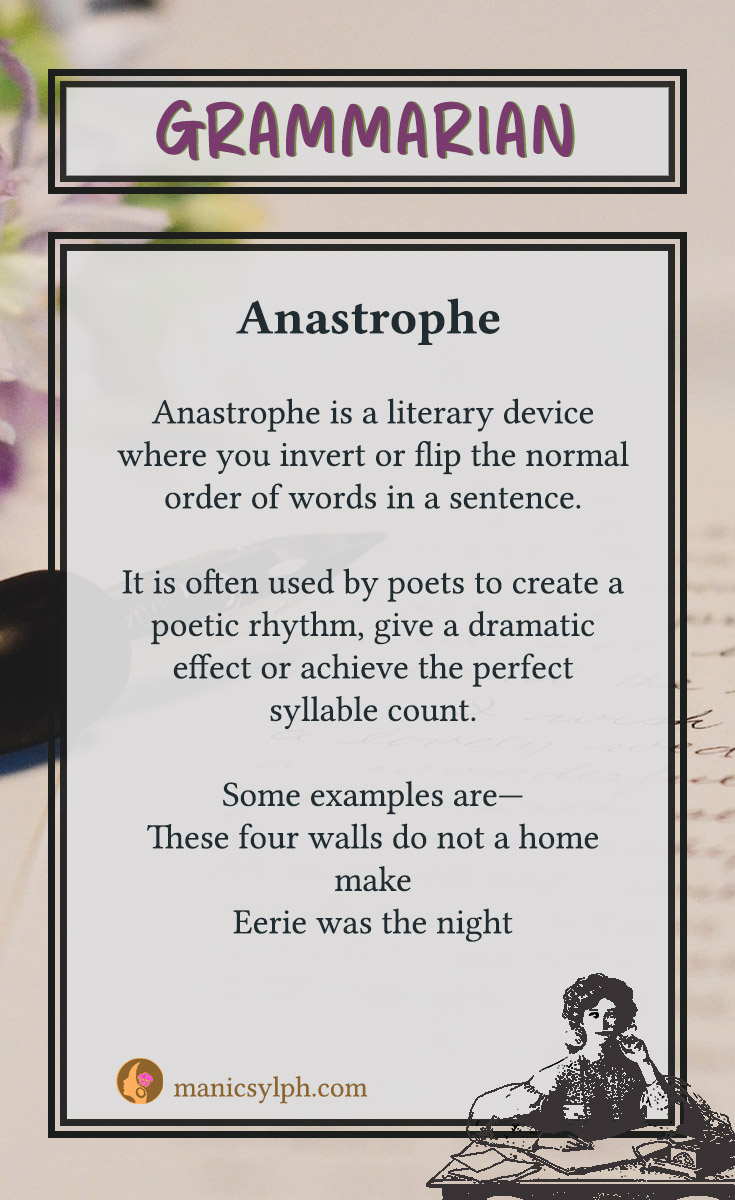
Anastrophe
Anastrophe is a literary device where you invert or flip the normal order of words in a sentence. It was often used by poets in earlier centuries, when poetry was typically written in strict rhyme and meter, as it helped push a rhyming word to the end of the sentence, create a poetic rhythm, or achieve the perfect syllable count.
Writers use an anastrophe to
—draw strong attention to the word that has been moved to an unusual position
—help to maintain a specific beat in the poem
—create drama
—give an old-fashioned feel to the verse
Examples of Anastrophe
Eerie was the night
These four walls do not a home make
Anastrophe in literature
“Deep into that darkness peering, long I stood there wondering, fearing…”
—Edgar Allan Poe (The Raven)
“Out of the cradle endlessly rocking, / Out of the mocking-bird’s throat, the musical shuttle…”
—Walt Whitman (Out of the Cradle Endlessly Rocking)
“A little learning is a dangerous thing; / Drink deep, or taste not the Pierian spring…”
—Alexander Pope (An Essay on Criticism)
The word Anastrophe comes from two Greek words, “ana” (which means “back”) and “strophe” (which means “turn”). Combined, anastrophe translates directly to “a turning back”. According to the Online Etymology Dictionary, the word entered the English language around the 1570s.
Use anastrophe to elevate your writing. When you do so, post the links in the comments. Inspire us with your creativity!
If you find GRAMMARIAN ~ Anastrophe interesting or useful, please share it forward.
“Knowledge shared is power multiplied” – Robert Noyce
To boost your word power, visit Vocabulary Wednesday. Read more, write better.


Share Your Thoughts