
SHORT STORY
THE GIFT
by SP Singh
Lumding, a nondescript railway station in Assam in north-eastern India, often wore a sleepy look. On a day, only a couple of trains passed through this junction. With hardly any work, Deka, its young station master, felt he was wasting his youth in such a place and waited for his transfer to a better station. The anonymity was his major concern. A glance at the basic amenities at the station told the story of his indifferent attitude towards the job. So what did he do during long, empty day hours? He just dozed off, often. But not that day, because a call from the district collector’s office had drawn a few worry lines on his otherwise unfazed face.
During the day, he ran around to arrange a brief stay for a VIP. And in the evening, it pleasantly surprised him when a woman stepped out of the car. He received her and ushered her into the retiring room. The accompanying police escort waited outside, on the veranda, as she freshened up. As soon as she emerged from the bathroom she found a man waiting with tea and biscuits. A cursory look at the clock gave her a sense of relief. She had only half an hour to board the train.
Chitrangada, the wife of the district collector of the North Cachar Hills, was traveling to her parent’s home in Kanpur. Her journey was necessitated by her grandmother’s sudden illness. Somehow she had a hunch that her grandma was clinging to the last thread of life and wanted to see her favorite grandchild before she breathed her last. Consumed by childhood memories, she forgot to enjoy the hot tea. By the time she realized, it had gone cold. Nonetheless, she drank it in one gulp and replaced the cup on the table.
The dull décor and lackluster ambiance of a railway retiring room could evoke melancholy in the heart of even the strongest optimist. She had lately been besieged by her differences with her husband whose preoccupation with his job had left him with little time either for her or for his family. Her impassioned pleas to accompany her home had been turned down tactfully. Despite his busy schedule, she knew he wasn’t interested in going with her. She had reasons to feel so because, in their seven years of marriage, they had been to her parent’s home only once. Apart from some trivial quarrels, theirs was a blissful marriage. Her brief journey down memory lane was cut short by the heavy sounds of the boots in the corridor. Within minutes she was at the platform waiting for the train.
It was well past midnight when she boarded the train and fell asleep almost instantaneously as the train moved out of the platform. When she awoke the next morning she found a man, in his mid-forties, sitting on the opposite seat. For a moment she was irked by a male’s presence but it was a train compartment and not her bedroom. And she could do little about that. The man, however, was looking outside the window. And that gave her some comfort.
Half an hour later she found herself a bit comfortable. Neither of them was ready to break the ice. She fidgeted in her seat as she felt an urgent need to redo her makeup but couldn’t. And she hated to revisit the toilet. Suddenly the train halted and the man moved out. Hurriedly she retouched her lipstick, applied moisturizer, and combed her hair. Then she replaced the cosmetics in her leather bag and occupied her seat.
To her pleasant surprise her co-passenger walked in with tea and said handing her a cup, “Ma’am, this is for you.”
“Thanks, I’m Chitrangada,” she said, “You can call me Chitra.”
“Chitrangada sounds better.”
“Yeah, for me too but nowadays people find my name quite ancient and everyone calls me Chitra.”
“No wonder. In the age of burgers and colas, we are fast losing our traditions and values.”
Then they fell silent for a while.
“Excuse me. What should I call you?” she asked, drawing his attention.
“Sorry. I forgot to introduce myself. I’m Tarun Varma. You might have heard about the gauge conversion between Lumdig and Silchar. I’m working as an engineer on the project.”
“I hope the conversion is completed soon.”
“Why? Have you ever traveled on that route?
“No, but from my husband I’ve heard a lot about the day journey between Silchar and Lumdig.”
“Horror stories,” he laughed.
She said nothing but just smiled.
He spoke apologetically, “I know the day-journey is quite long and tiring but perhaps not everyone is aware that the route is an absolute visual delight as the train passes through breath-taking countryside.”
“I didn’t know that,” she expressed surprise. “I hope to undertake a journey someday. Hopefully, by then trains would have begun to move faster.”
“If your husband is around this place for another four years.”
A feeble smile spread on her lips. Then she said, “You know that’s not guaranteed.”
“I guess that’s a small price to pay to be a collector’s wife,” he remarked.
“No, that’s a huge price,” she protested, mildly. “It’s a fallacy the bureaucrats live a cushy life.”
Feeling the hurt in her voice, he immediately made amends, “Sorry. I’ve little knowledge about your husband’s profession.”
During the brief silence, she regained her calm. He was relieved. After a cursory peep outside the window, he turned to her and enquired, “Chitrangada, what’s your profession?”
“I work in my husband’s house,” dimples appeared as she smiled. “I mean I’m a housewife. Some women, however, call it by a fancy name like a house manager but the fact remains the same and the job is similar whether you’re a poor man’s wife or a millionaire’s.”
For a while, he looked perplexed and felt stupid at the choice of his question. As far as his knowledge went he knew the wives of most bureaucrats were working women, mostly in the same profession. Oddly his co-passenger was an exception. Curious, he probed further, “So, I guess you’re happy as a house manager unlike many women of today who seek a distinct career and identity for themselves.”
“Some years ago I too was very much like the other girls, full of dreams to achieve something in life and so I did my MBA. For less than a year I worked in a company. Then I fell in love with Neeraj, who was doing his training in Mussoorie where I had gone with my friends for holidays. It was an accidental meeting and love at first sight.”
“And you married him.”
“Yeah, you’re right.
“So where was the hitch in continuing with your job?”
She became pensive and a bit tense. He waited anxiously for her answer. And when she stirred, he breathed easy.
“On the day Neeraj proposed to me he said that he wanted a wife.”
“And he had one,” said Tarun in a sad tone.
“Yeah.”
Though he did understand what went on in her mind that moment, he tried to comfort her, “I’m sure you must be having a wonderful life as a collector’s wife.”
Her response was a huge smile. Fearing he might dig further into her life, she looked at him and asked, “Where’s your wife?”
“At home in Lucknow. She runs a boutique there,” his response was plain. “Since I never get to stay at a place for more than six months, it’s difficult for us to stay together.”
“Lucky girl,” she mumbled.
“Did you say something?”
“No, nothing.”
He fell silent. Perhaps she had touched his sensitive nerve, she felt. For a moment when she saw his eyes, she found a profound sadness in them. She felt guilty for broaching such a sensitive subject with him. His eyes had begun to fill. The man could burst into tears at any moment and might need a shoulder to lean on. At that moment she felt vulnerable. So she excused herself and quietly slipped away. At the other end of the compartment, she occupied a vacant seat where she stayed until the arrival of the next station. When she returned to her seat she found him engrossed in a book. His eyes had been wiped clean, she noticed. A little later they had lunch together.
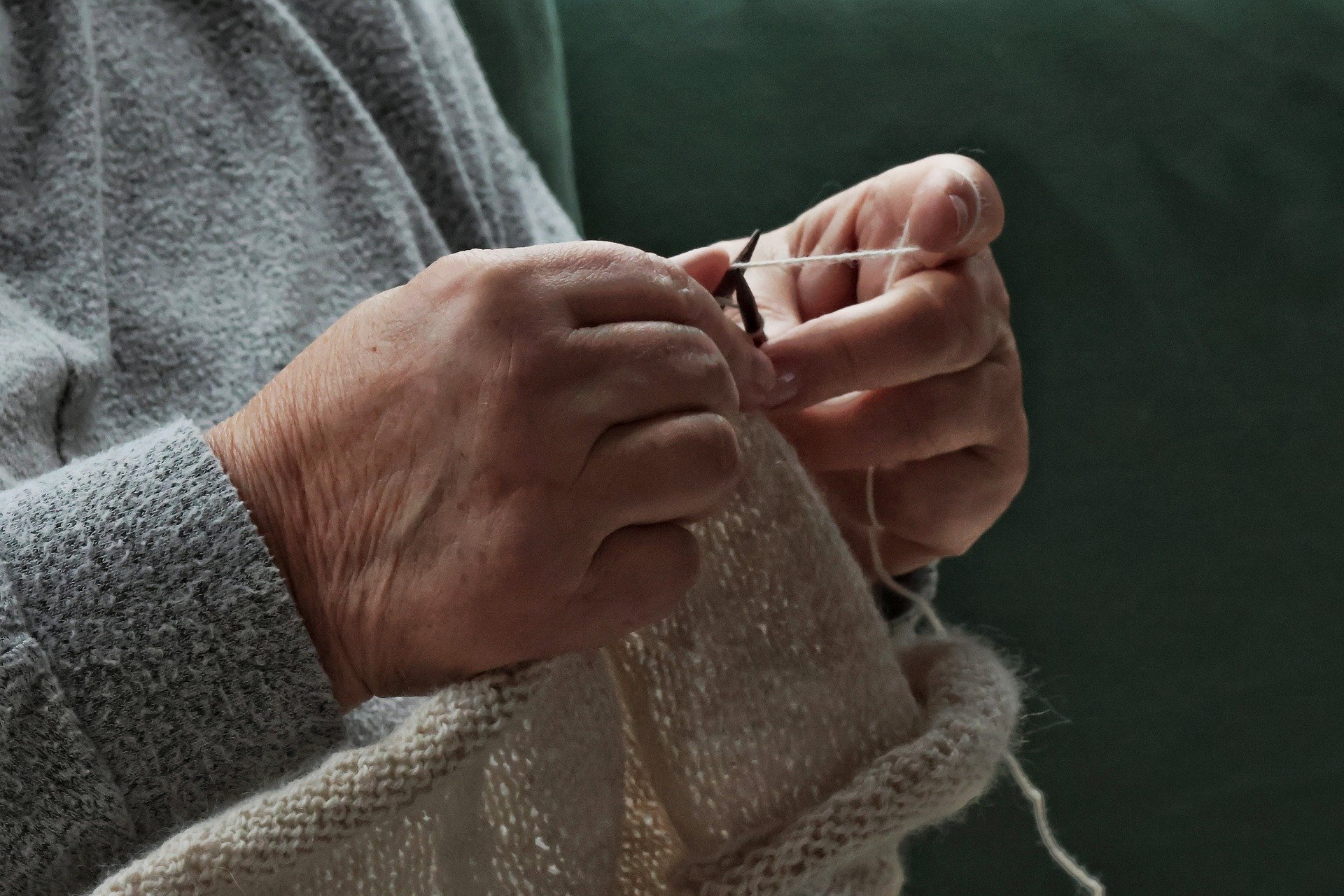
After lunch, she opened the bag and took out a pair of knitting needles and a bundle of light brown wool. Then she began to knit. Neeraj, her husband, had purchased the wool and it was his favorite color. Before leaving home she had promised to knit a sweater for him. Though she had been knitting it for almost a month, somehow she hadn’t been able to finish it. The train journey, she thought, would give her enough time to complete the sweater and surprise her husband with it.
From the corner of her eye, she looked at him. He was engrossed in the book. As the train picked up speed so did her knitting, which she had learned from her grandmother. Contrary to her friends’ opinion she enjoyed knitting. It acted as a stress buster for her.
Suddenly a waiter appeared and asked them for tea. Both almost said in unison, “Yes.” Then he kept aside his book and was amazed to find her knitting. He couldn’t help but remark, “So you know it.”
“Why? What’s so surprising about it?” she replied, placing needles on the seat and exercising her aching fingers.
“I find it quite strange. I mean an MBA graduate and a collector’s wife reviving a dying art.”
“Oh, I understand. In a way you’re right. Not many educated city girls know how to knit. I learned it from my grandma who knows so many designs. She is the best in the family. People say that she never repeated a design ever and she must have knitted more than a hundred sweaters, pullovers, and cardigans. Unfortunately, I could learn only a dozen. I hardly get time at home. During train journeys, though, I manage to knit one or two.”
“Your husband is a lucky guy. The feel of a sweater knitted by someone special on a wintry night must be exquisite. I mean a unique experience.”
“Why? Hasn’t anyone knitted you a sweater?”
“In my family women are too lazy to knit a scarf, let alone a sweater. My wife hates needles. I sometimes wonder how she runs a boutique.”
There, she was sitting opposite a man who was so sentimental about hand-knitted sweaters but possessed none. On the other hand, her husband for whom she had knitted a dozen sweaters had never expressed any sentiment like that.
For the remainder of the journey, they conversed with each other on various subjects and when they got tired of talking, he switched to reading and she to knitting. In between he did look admiringly at her fingers, which moved like a professional’s. And before the penultimate station arrived, she had finished the sweater. He brought her hot tea from the station and both had it quietly. Half an hour later he was to alight at Lucknow. After having tea he began to pack his luggage. One moment he waited anxiously for the next station, and the next he wished his journey had never ended. It just went on and on, forever. Why? He didn’t understand. Neither his mind nor his heart had an answer.
Unenthusiastically he watched the faint lights of the villages pass by. His hometown was to arrive any moment.
“Excuse me,” he heard her say.
“Yes,” he turned back.
“I have a gift for you. I hope you won’t refuse it,” she had a neatly wrapped packet in her hand.
“What have I done to deserve this?” he asked foolishly.
“It’s for the trouble you took during the last twenty-four hours to get me hot tea from the stations,” she spoke with a pleasing smile.
For several seconds he remained too overwhelmed to say anything. Later he thanked her profusely and asked with a childlike sparkle in his eyes, “What’s in this?”
“Open and see for yourself,” she shot back.
Hurriedly he opened it and was shocked to find a sweater. It was the same one she had been knitting on the train. Suddenly his heart was weighed down by a sense of guilt. That sweater was for her husband. How could he ever accept it? He argued in his mind and spoke politely, “Chitrangada, though this is the best gift of my life, I can’t accept it. Neeraj is its rightful owner.”
“Believe me. You deserve more than him,” she insisted. “I’ll make him another one.”
“Thank you so much. I shall treasure it all my life,” he wiped his misty eyes.
“It’s not for safekeeping. Do wear it sometimes. I’ll feel happy,” she laughed.
His lips parted into a feeble smile. A few minutes later the train halted. They shook hands and wished each other luck. Outside the station, the weather was a bit chilly so he instinctively put on the sweater. Half-hour later he was home with his wife and children. They were excited. As his wife hugged him, the sweater caught her by surprise. She touched it and asked, “Nice sweater. Where did you get it? I mean who gifted it.”
“Chitrangada,” he said hastily. The afterglow of the joy of getting the gift still lingered on his face. And he made no effort to hide it.
“Is she your cousin?” she asked but couldn’t take her eyes off the sweater. Then she felt it between her fingers and stared at it. “Darling, this design is very, very exclusive, the kind a woman makes for someone special.”
“How did you judge that?” he asked.
“I run a boutique and don’t forget I’m a designer too.”
“But you never knitted a sweater.”
“So what?” she snapped back. “A woman can never miss the sentiments behind making a garment.”
“All right, I believe you,”
Then he removed his clothes and went to the washroom. She put them in the laundry bin, lifted the sweater, and brought it close to her nose. The faint female scent had been smothered by a strong jute odor. The love and tenderness of the knitter glittered in every round and purl. Jealousy passed through her like a thunderbolt. Today it was a sweater, tomorrow it could be anything. A sudden fear engulfed her that he could succumb to the temptation due to her long absences. She needed to spend more time with him. A few months in a year were inadequate. Then she hid the sweater in her cupboard, rang her friend, and asked if she could teach her knitting. A positive answer smoothed her forehead creases.
“Why? What happened?” her friend asked.
“I’ll tell you tomorrow,” she replied and hung up. Then she took a deep breath, wiped her face with her palms, and went to the kitchen.
After freshening up he had tea with his wife at the dining table. They exchanged smiles. His smile hid it all. Her smile said it all.
Connect with SP Singh on Facebook
Connect with SP Singh on X (former Twitter)
SP Singh, an army veteran, is a novelist, short story writer and painter. His debut novel, ‘Parrot under the Pine Tree’ was shortlisted for the Best Fiction Award at the Gurgaon Literary Festival and nominated at the Valley of Words Literary Festival in 2018. His short story, ‘Palak Dil,’ won the South Asian Award for Micro Fiction in 2019. His story, ‘The Broken Window’ has been published in UNSAID, An Asian Anthology by Penguin Random House SEA in 2022 and ‘Cherrapunji’ has been published in an anthology, ‘No One Should Kiss a Frog’.

Please don’t forget
to support the writer!
Tell us your thoughts
Share this page
Visit SP Singh
Choose Your Next Read
Poetry:
Hard To See More Than A Stonecast
Poetry:
A Death In The Town
Poetry:
Untitled
Poetry:
Petal Poem
Fiction:
The Lights of Asvalen
Fiction:
Cloud People
Fiction:
The Gift
Fiction:
Thistle
Fiction:
The Cost of Visualization
Fiction:
CartoScan
Fiction:
A Time to Live
Fiction:
It’s the thought that counts
Insights:
Character Creation 101 – How to Write a Character with PTSD
Book Review:
In The Shadow of Rainbows
Book Review:
Honeysuckle Heat
Book Review:
Séduire: Serial Tales & Flash Fiction
Picture Prompt:
Eternal Puppeteer
 Manic Sylph Writes... Poetry & Thoughts by Mona Soorma
Share Your Thoughts