
A WRITER’S LIFE
ELIZABETH BARRETT BROWNING
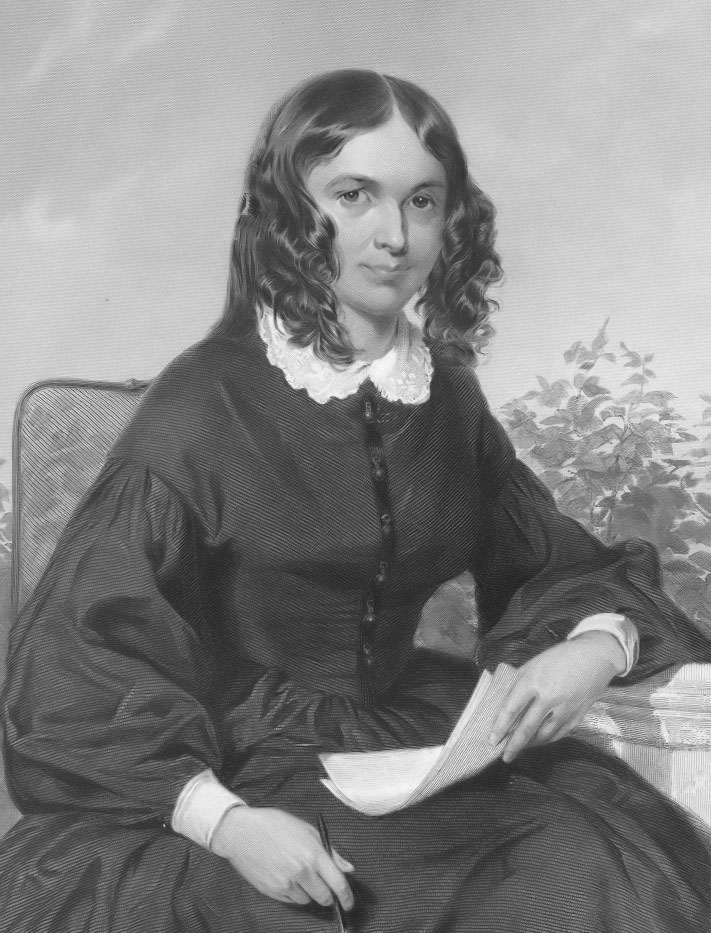
Elizabeth Barrett Browning, an English poet of of the Romantic Movement, is known and admired for her powerful and passionate verse. Born on March 6, 1806, in Coxhoe Hall, Durham, England, she was the oldest of twelve children born to Edward Barrett Moulton-Barrett, a wealthy landowner who owned sugar plantations in Jamaica that were run by the forced labor of enslaved people. Her father decided to raise his children in England after his family had lived in Jamaica for almost two centuries. Elizabeth received an exceptional education at home. She immersed herself in literature, languages, and philosophy.
Barrett Browning’s first known poem was written at the age of six or eight, “On the Cruelty of Forcement to Man”. Her mother compiled early efforts of her poetry into collections of “Poems by Elizabeth B. Barrett”. She battled with the effects of lung disease and a spinal injury all her life and became weak and frail. She was dependent on morphine for much of her adulthood. It is believed that this may have contributed to the wild and vividness imagination in her poetry.
After her brother died by drowning, Browning was emotionally broken, and spent the next five years in her bedroom. She continued writing and in 1844 produced a collection entitled simply Poems. Robert Browning, whose work Elizabeth had praised in one of her poems, wrote her a letter. They exchanged 574 letters over the next couple of years. Their romance was bitterly opposed by her father and In 1846, they eloped and settled in Italy, where Elizabeth bore a son. Elizabeth’s Sonnets dedicated to her husband were published in 1850.
Her poetry addressed social and political issues and earned her widespread recognition and admiration. Tragically, Elizabeth succumbed to an illness in Florence, Italy, on June 29, 1861. Her powerful poetry continues to be admired for its emotional depth, lyrical beauty, and enduring themes.
CHANGE ON CHANGE
A poem by Elizabeth Barrett Browning
1.
Three months ago, the stream did flow,
The lilies bloomed along the edge;
And we were lingering to and fro,—
Where none will track thee in this snow,
Along the stream, beside the hedge.
Ah! sweet, be free to come and go;
For if I do not hear thy foot,
The frozen river is as mute,—
The flowers have dried down to the root;
And why, since these be changed since May,
Shouldst thou change less than they?
2.
And slow, slow as the winter snow,
The tears have drifted to mine eyes;
And my two cheeks, three months ago,
Set blushing at thy praises so,
Put paleness on for a disguise.
Ah! sweet, be free to praise and go;
For if my face is turned to pale,
It was thine oath that first did fail,—
It was thy love proved false and frail!
And why, since these be changed, I trow,
Should I change less than thou?
Don’t forget to support Lit eZine! Share this page forward.
Choose Your Next Read
Author Spotlight:
Poetry by Suzanna C. de Baca
Author Spotlight:
Flash Fiction by Suzanna C. de Baca
Author Spotlight
Interview: Suzanna C. de Baca
Poetry:
The Dancer
Poetry:
Patriarchs Anonymous
Poetry:
Agamond’s Lament
Poetry:
Lost Souls at Night
Poetry:
Gaia
Poetry:
Until Morning
Poetry:
Even The Poor Have Stars To Guide Them
Poetry:
Summer, Ballgown, Symphony
Poetry:
Snow Poured Out…
Poetry:
Cri Du Coeur
Poetry:
With
Poetry:
Two Points
Poetry:
Ladybird
Poetry:
Essence
Poetry:
Tan-Renga
Poetry:
They Came For Mangoes
Poetry:
Duplicity
Poetry:
My New Nose
Fiction:
Two Brothers
Fiction:
The Gate Lodge
Fiction:
Family Connections
Fiction:
A Deceitful Dream
Fiction:
Her Partial Presence
Fiction:
Our Last Night as a Fancy Couple
Insights:
When You Get Tired of Your Own Nonsense
Insights:
Lessons For Life
A Writer’s Life:
Elizabeth Barrett Browning
Picture Prompt:
The Untold Story
 Manic Sylph Writes... Poetry & Thoughts by Mona Soorma
Share Your Thoughts